MODULAR GREENHOUSE ROOF
Wind-Induced Pressure Field Characterization on Modular Greenhouse Roofs
Year: 2019
This study addresses the wind loading on a class of industrial modular greenhouses, with the specific objective of characterizing the pressure field induced by atmospheric wind on a cylindrical-vault roof geometry. The reference greenhouse cross-section was selected in agreement with the Client among a set of candidate configurations, and it is defined by an arch rise-to-span ratio of 0.286, representative of a relatively slender vaulted canopy. Because curved roofs of this type may exhibit strong sensitivity to both geometric parameters and flow regime, the work was conceived not as a single test campaign, but as a structured experimental programme combining a broad literature survey with a sequence of targeted wind-tunnel sensitivity studies, ultimately aimed at producing design-ready pressure coefficients for engineering applications.
A preliminary state-of-the-art review was first conducted to frame the experimental choices and to identify the dominant mechanisms governing wind pressures on cylindrical-vault roofs. While no published case was found to match the Client’s geometry closely, the literature provided a robust set of methodological guidelines for laboratory testing. In particular, it highlighted the marked dependence of pressure-coefficient distributions on the transverse section shape, the need to work beyond a minimum Reynolds-number threshold to mitigate scale effects, the influence of the building aspect ratio on the persistence of end effects along the roof, the necessity of measuring both internal and external pressures when openings are present to obtain net design pressures, the usefulness of “dummy” models to reproduce interference effects with adjacent structures, and the sensitivity of results to the characteristics of the incident atmospheric boundary layer.
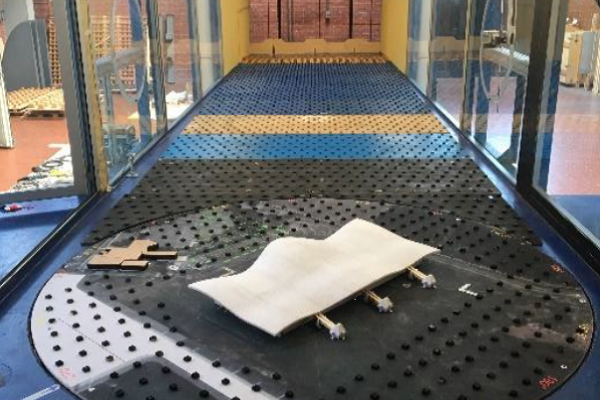
Consistently with these indications, the experimental campaign was performed under a reproduced atmospheric boundary layer representative of open-terrain exposure conditions. The target mean velocity profile, turbulence intensity and integral length scales were generated using dedicated surface roughness elements distributed along the wind tunnel development length and complemented by upstream turbulence-generating devices to achieve the required turbulence levels. The boundary-layer properties were then measured and validated through an automated traversing system, ensuring that the model was exposed to a controlled and repeatable turbulent inflow consistent with engineering standards for civil structures.
The geometric scale was selected to guarantee both an accurate boundary-layer simulation at model height and a sufficiently low blockage ratio, maintained well below the typical 5% threshold. A design-consistent velocity scale was adopted by matching the mean wind speed at the reference height in the tunnel to an equivalent target reference wind speed at full scale. This allowed time and frequency scaling to be defined explicitly so that the recorded pressure time histories could be interpreted at prototype scale, both in terms of mean pressures and in terms of dynamic content. The acquisition strategy was therefore designed to ensure adequate bandwidth and statistical convergence, with long enough records to obtain stable estimates of mean and peak quantities while preserving the spectral content relevant to wind loading.

Manufacturing process of the double-side instrumented dome (external and internal pressures).
Two geometrically identical canopy models were manufactured, each having a longitudinal length equal to twice the roof span to represent a modular greenhouse segment with a reference aspect ratio. One model was instrumented with pressure taps, while the other was left unperforated to serve as a dummy element when required by interference and aspect-ratio studies. The roof shells were produced from thin steel sheets pre-drilled at the pressure-tap locations and then formed to the required curvature, supported by steel ribs, yielding a stiff and dimensionally accurate representation suitable for pressure testing.

Pseudo-laminar testing setup for the positioning of the sand paper strips and Reynolds effects.

Comparison of mean pressure-coefficient maps on the external surface of the smooth model (left) and of the model equipped with a sandpaper strip (right). Dashed lines indicate the code-based subdivision of the roof into two lateral edge zones and two central zones along the vault.
A key part of the programme was the systematic investigation of Reynolds-number sensitivity and transition effects, which are known to be significant for curved roofs. A dedicated set of exploratory tests was therefore carried out by combining different flow conditions, wind speeds and controlled surface treatments. Measurements were performed both in a quasi-uniform, low-turbulence approach flow and under the reproduced atmospheric boundary layer, while varying the mean speed to span a range of Reynolds numbers. In addition, a technical roughness strip was introduced at different streamwise positions to force boundary-layer transition, acknowledging that the effective transition point is not known a priori at model scale. The results showed that surface-transition control can measurably alter the pressure distribution, with clear consequences for the global load components inferred from the pressure field. On an engineering basis, and to provide a conservative and usable envelope for design, the study concluded that different surface conditions should be considered depending on the load effect of interest: the smooth configuration is the more appropriate reference for uplift-driven actions, whereas the transition-forced configuration provides a more conservative basis for drag-driven actions. Importantly, the Reynolds-number range achieved in the wind tunnel was consistent with, and exceeded, the minimum threshold recommended by the literature, supporting the reliability of the derived pressure patterns.

Aspect ratio sensitivity studies schematic.
A second family of sensitivity studies addressed the effect of aspect ratio and end effects, which can significantly modify the pressure field for wind perpendicular to the roof ridge. The modular greenhouse segment was first extended artificially by placing an adjacent dummy module, thus increasing the effective aspect ratio and allowing a direct assessment of how the central region of the roof evolves as three-dimensional end effects are pushed further away. The comparison revealed that the suction region around the crown is sensitive to the longitudinal extent and that end effects can influence a length of the order of one roof span along the building. To further isolate and interpret these effects, additional configurations were tested by extending the module at both ends with transparent add-ons and, in the limiting case, by introducing end plates to suppress end effects and approximate the behaviour of a very long greenhouse segment. These tests provided a consistent picture of the distance over which edge effects persist and clarified the tendency toward a quasi-two-dimensional pressure field in the central roof region as the effective aspect ratio increases.

Resulting pressure map for an effective aspect ratio AR = 4, obtained by mirroring the half-roof map and compared against the corresponding AR = 2 case. The extent of the region affected by end effects, of the order of the roof span D, is highlighted.
Since industrial greenhouses are often deployed in arrays, the campaign also included an exploratory interference study to quantify qualitatively how an upstream neighbouring module can alter the pressure field on a downstream greenhouse. By varying the spacing between an upstream dummy module and the instrumented model and testing representative wind directions, the results demonstrated the coexistence of shielding effects—reducing pressures and suctions over parts of the windward region when the upstream element is close—and, for other incidence angles and separations, the possibility of locally increased loading due to wake interaction and flow reattachment patterns. While the study was intentionally exploratory, it confirmed that interference can materially change the pressure maps and that dedicated testing is valuable for deriving realistic and conservative load envelopes when greenhouses are arranged in multiple rows.

Proximity modules sensitivity study.
Pressure coefficients were defined and provided in a form directly usable for design. For each wind direction, time histories were normalized by the mean dynamic pressure at the reference height in accordance with standard wind-engineering practice, yielding external and internal pressure coefficients and enabling the derivation of net pressure coefficients required for structural design. Both internal and external pressures were measured to support configurations with closed and open sides, leaving the final combination of internal and external contributions consistent with the relevant design code framework. Peak pressure coefficients were estimated through a time-averaging approach based on moving windows corresponding to one second at full scale, followed by extraction of extrema over multiple observation intervals and subsequent averaging, providing robust design-oriented peak values without over-penalizing local elements through excessively conservative pointwise assignment.
Overall, the study delivered a technically justified experimental basis for the interpretation and use of wind-induced pressure data on modular cylindrical-vault greenhouse roofs. The simplicity and generality of the underlying geometry required an unusually careful preliminary phase and a broad set of sensitivity tests to ensure that the resulting pressure maps are both representative and conservatively applicable to industrial modular products expected to be deployed in highly variable wind climates worldwide. The work also clarifies the limits of generalization: results are strictly tied to the tested geometries and the reproduced incident boundary layer, and further dedicated investigations remain advisable when moving toward substantially different configurations, large greenhouse arrays, or markedly different exposure categories.