NEW PORT CONTROL TOWER in an (Genova, Italy)
Wind Tunnel Investigation of the Genoa Port Control Tower
Year: 2022
The wind tunnel campaign was carried out to refine and validate a set of aerodynamic parameters previously adopted as input data for the preliminary dynamic analyses of the Genoa Port Control Tower under turbulent wind conditions. Those earlier assessments had highlighted a marked sensitivity of the structure to atmospheric turbulence, motivating a dedicated experimental programme aimed at improving the accuracy and reliability of the aerodynamic characterization used in design-oriented evaluations.
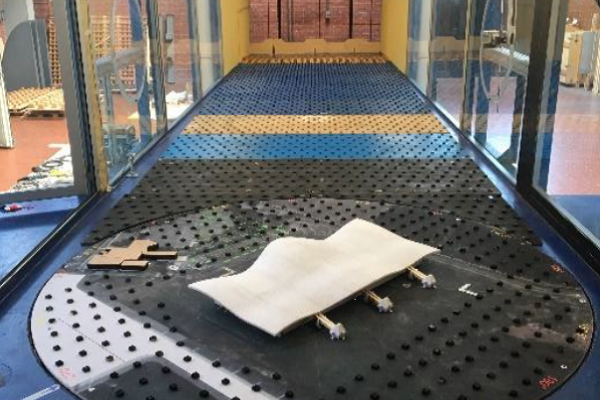
The experimental strategy was articulated around the use of three distinct scaled models, each tailored to investigate specific components of the structure and complementary aspects of the wind–structure interaction. This modular approach made it possible to address the complexity of the tower by separating global force measurements, local pressure measurements and aeroelastic stability issues, while maintaining overall coherence among the results.
The first model reproduced the lattice shaft of the tower, including the external staircase, elevator support structures and service pipes. Its primary objective was the determination of mean aerodynamic force and moment coefficients as a function of the horizontal wind incidence, providing a detailed characterization of drag, lift and torsional effects acting on the portion of the structure below the cabin. In addition, this model was specifically conceived to investigate the potential onset of torsional galloping. For this purpose, the model was also tested in an aeroelastic configuration, allowing torsional oscillations about the longitudinal axis and enabling a direct experimental verification of aeroelastic stability under uniform wind conditions. The adopted setup was intentionally conservative with respect to the full-scale structure, ensuring that the absence of instability at model scale could be interpreted as a robust indication of stability at prototype scale.


The second model focused on the upper part of the tower, namely the cabin and the roof. It was designed to measure global aerodynamic forces and moments acting on this assembly, accounting for the combined effects of pressure and tangential stresses induced by the wind on the exposed surfaces. Through force-balance measurements performed over a range of wind incidence conditions, this model provided aggregate aerodynamic coefficients for the cabin–roof system, as well as the slopes of lift and moment coefficients required for dynamic analyses. Particular attention was paid to isolating the aerodynamic contribution of the structural components of interest, separating it from that of auxiliary elements introduced solely for testing purposes.

The third model also represented the cabin and roof, but was specifically optimized for pressure measurements. In this case, the structure was instrumented with a dense array of pressure taps, allowing the reconstruction of detailed pressure fields over the external surfaces. This approach enabled a twofold objective: on one hand, it provided an independent confirmation of the global force coefficients obtained from the second model; on the other hand, it allowed the estimation of the aerodynamic admittance of the roof, defined as the transfer function between turbulent wind velocity fluctuations and the resulting unsteady aerodynamic forces. Measurements were carried out in turbulent flow conditions representative of atmospheric boundary-layer characteristics, making it possible to capture the frequency-dependent response of the structure to wind turbulence.


The combined use of these three models resulted in a comprehensive experimental framework. Global force measurements clarified the distribution and magnitude of aerodynamic loads acting on the different parts of the tower, while pressure measurements offered insight into the spatial organization of wind-induced effects and into the dynamic filtering properties of the structure. The aeroelastic tests performed on the lattice shaft further ensured that potential instability mechanisms, such as torsional galloping, were explicitly investigated and ruled out within a conservative experimental setting.
Overall, the wind tunnel campaign provided a refined and internally consistent set of aerodynamic parameters for the Genoa Port Pilot Tower, significantly improving the basis for subsequent dynamic assessments under turbulent wind. The results confirmed the sensitivity of the structure to atmospheric turbulence already identified in earlier studies and highlighted the importance of accurate aerodynamic characterization for slender and articulated towers in complex exposure conditions. Within this context, the experimental work represents a clear example of how wind tunnel testing can support engineering decision-making by reducing uncertainty and guiding the definition of appropriate mitigation measures when required.

Geographic and Urban Context of the Pilot Tower
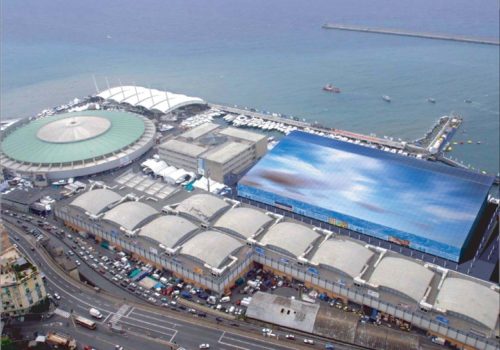
The Genoa Port Pilot Tower is situated immediately adjacent to the exhibition and fairgrounds area of Genoa, a dynamic urban waterfront characterized by a diverse assembly of architectural and infrastructural elements. From a bird’s-eye perspective, such as that provided by Google Earth imagery, the tower emerges as a slender vertical element within a landscape of low-rise exhibition halls and roofed spaces, including the nearby complex for which a dedicated wind tunnel study was also conducted and featured elsewhere in this portfolio. This juxtaposition of forms underscores the challenge of addressing wind effects in a mixed built environment where tall, exposed structures and broad, low-profile coverings coexist. The proximity of these two engineered elements has reinforced the need for advanced wind engineering analysis to ensure that both aesthetic objectives and structural performance criteria are met under the local wind climate of the Ligurian coast.