TWO LARGE COVERING SYSTEM FOR ex-ILVA STEEL PLANT (Taranto, Italy)
The new fossil and mineral storage area covering system
Year: 2018
Stringent environmental regulations may require industrial facilities to cover certain processes or materials to control emissions and reduce environmental impact. Covering systems can be implemented to capture and control particulate matter, dust, and other pollutants, improving overall air quality in the surrounding area; covering the critical areas can enhance safety for workers and citizens of Taranto by minimizing exposure to hazardous substances and other potential risks. That was the decision taken in the case of ex-ILVA steel plant, for which over the years several countermeasures were undertaken without success in avoiding the dust and powder to be blown around the city, in particular the Tamburi neighborhood.
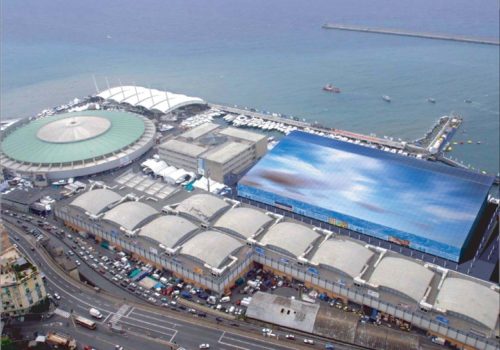
Given the extremely large area to be covered, no conventional roofing construction could have been considered. In fact, CIMOLAI developed an original modular system employable in such a case. Two very long and large ‘twins’ structures were designed in order to cover the areas, called ‘fossil’ and ‘mineral’ parks, in which the fuel material to supply the furnaces is stored. The goal is to be able to protect by wind two strips of land 265 m wide and 476 m long; the laboratory tests interested this configuration, being a first phase to be, if needed, extended in a second moment to 700 m. The height of both structures is 78 m, hence the geometric scale resulted to be 1:600, which complied with the wind profile characteristics set-up and with blockage considerations.


The wind profile prototype target was previously studied and assessed by the research group at DICCA (University of Genoa – UNIGE), for all the wind incidences at the construction site. Moreover, a preliminary wind tunnel campaign was conducted on smaller scale models in the 700 m long coverings configuration. It was our pleasure to conduct our campaign in close contact with UNIGE group and in particular with the distinguished Prof


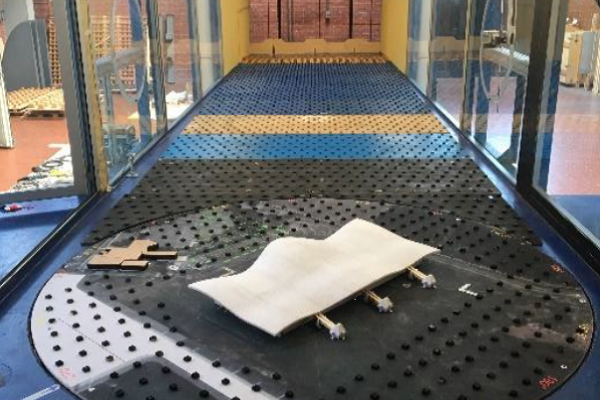
Four configuration of pressure taps were designed in order to study the whole single covering or specific parts more finely instrumented. For example, a sensitivity study for the technical roughness mounted to reproduce a realistic effect of the lack of buildings in a vast area in front of the façades.


It was apparent that a quite detailed pressure field has to be reconstructed from punctual measurement points, distributed through the whole roofing system and more refined in the most delicate areas.
To accomplish all goals a model was designed and constructed, for instrumenting the whole roofing, 1:300 geometrically scaled and instrumented with 254 simultaneously measuring pressure taps. Wind tunnel tests have been carried out aimed to the evaluation of the pressure field of the entire envelope of the roofing system, presenting and overhand strip on the external perimeter, so that net pressures had to be measured on that. This represented the most tricky phase in the physical model realization.