STUDY ON A NEW COVERING SYSTEM
STUDY ON A NEW COVERING SYSTEM
Year: 1998-1999
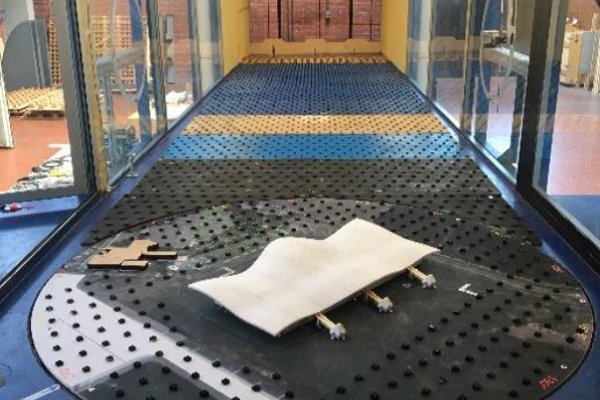
At the end of the Eighties a portion of the Exhibition Authority (Ente Fiera) area was extended and new spaces needed to be covered. It was decided to employ and design tensile structures, but, at the moment of wind tunnel testing on the roofing system, the size of the effective new area was still uncertain so that more than one only configuration was tested. Aerodynamic pressure field were measured by equipping a rigid model and the surrounding area, conduction the test in the boundary layer measuring section of the wind tunnel, so to be able to tests eight oncoming turbulent flow angles of attack.


Located within the urban fabric of the historic port city of Genoa, the wind engineering studies conducted for the new covering system are integrally connected to a broader programme of structural innovation in the same area of the Genoa fairgrounds. Immediately adjacent to this complex of exhibition halls and roof structures stands the recently completed Genoa Port Pilot Tower, a slender and architecturally distinctive landmark that has reshaped the skyline along the waterfront. The proximity of these two engineering endeavours — the innovative roof covering and the pilot tower — underscores a shared aerodynamic environment and the necessity of context-sensitive wind engineering.
In both cases, the presence of complex three-dimensional geometries and the influence of local wind regimes associated with the exposure over the Ligurian Gulf made it imperative to integrate wind tunnel testing into the design process. The insights gained from the pilot tower campaign, described elsewhere in this portfolio, not only informed the structural verification of a tall, slender tower in a turbulent maritime boundary layer, but also offer valuable empirical reference for interpreting wind effects on adjacent structures at similar scales and orientations.
By situating the new covering system and the pilot tower within a common geographic and meteorological context, this narrative highlights the value of coordinated wind engineering strategies in urban waterfront developments. Together, these projects illustrate how wind tunnel experimentation can contribute to a resilient and performance-oriented built environment where architectural ambition and environmental forces interact in complex ways.