The experimental investigation of unsteady aerodynamic phenomena on sectional models requires highly specialized testing systems capable of imposing controlled structural motion while accurately capturing the resulting aerodynamic response. Forced vibration systems in torsion represent a powerful and well-established experimental approach in wind engineering, allowing researchers to decouple the imposed motion from the aeroelastic response and to investigate fluid–structure interaction under fully controlled conditions.
By prescribing the rotational motion of the model, such systems enable the study of unsteady aerodynamic forces, aerodynamic derivatives, and pre-critical instability mechanisms that are often difficult or impossible to isolate in free-vibration tests. While the methodology is widely applicable in fundamental research, its primary engineering relevance lies in the analysis of bridge deck and footbridge sections, where torsional motion plays a key role in flutter, vortex-induced vibrations, and other aeroelastic phenomena.
System Concept and Design Philosophy
The forced torsional vibration system developed at CRIACIV is conceived to be mounted on fixed elements of the wind tunnel structure and is designed with a minimal number of mechanical components, ensuring robustness, repeatability, and cost-effectiveness. The core design choice consists in directly imposing the pitching rotation of the sectional model through high-performance brushless motors. This solution is particularly suitable for tests involving large oscillation amplitudes and high angular accelerations, conditions that cannot be reliably achieved with alternative actuation systems.
A key requirement of the setup is the minimization of torsional inertia, which is essential to accurately impose the desired motion while avoiding spurious dynamic effects. For this reason, the use of conventional force balances was deliberately avoided: in forced-motion tests, inertial forces associated with the imposed acceleration would dominate the measured signals, making the detection of aerodynamic contributions unreliable.
Mechanical Layout and Model Configuration
The system is composed of two brushless AC motors (INFRANOR MAVILOR, BLS-144 type), rigidly mounted on aluminum profiles fixed to the external wind tunnel structure. The motors are aligned along the model axis and operate in a synchronized configuration, directly driving the torsional motion of the sectional model.
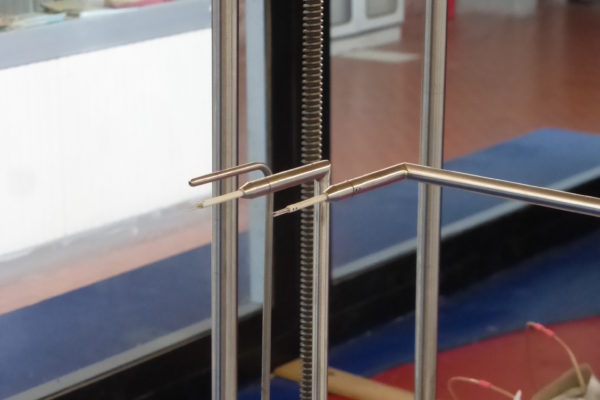
The current reference configuration employs a sectional model with a length of 1.2 m, selected to limit the length of the pressure tubing system and minimize signal distortion. Although a NACA 0021 airfoil (with chord length c = 200 mm) is reported in the figure below to show the rig, the system is explicitly designed to accommodate sectional models representative of bridge decks and pedestrian bridges, which constitute its main application domain.