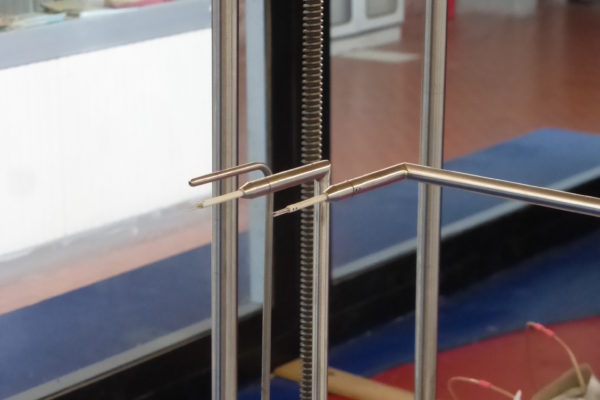
The measurement of aerodynamic forces on physical models represents one of the most complex and specialized areas of applied fluid mechanics and wind tunnel experimentation. In general, aerodynamic loads must be measured simultaneously along multiple directions, typically involving three force components (drag, lift, and lateral force) and the associated three moments. Capturing both mean and fluctuating components of these loads is essential, as they can be generated by highly complex flow phenomena such as flow separation, shear layer impingement, wake interactions, and vortex shedding.
One of the main challenges in force measurements lies in the wide range of magnitudes that must be resolved. On one hand, instruments must feature a sufficiently high full scale (FS) to withstand and accurately measure large force components induced by strong flow impingement or wake interactions. On the other hand, they must also be capable of resolving very small fluctuating components superimposed on already significant mean loads. This requirement calls for extremely high accuracy, low noise levels, and an FS carefully tailored to the specific application, making the design and selection of force measurement systems a critical task.
At CRIACIV, aerodynamic forces are measured using high-precision multi-component balances integrated into purpose-designed experimental rigs. The core instrumentation includes two ATI six-component strain-gauge dynamometers (FT-Delta model), typically employed for force measurements on sectional models, where two identical balances are installed at the two ends of the model. Thanks to their compact size, these sensors are also suitable for other applications requiring multi-axis force measurements in confined spaces.
In addition, CRIACIV has progressively integrated a force measurement system developed by Kistler, based on piezoelectric sensing technology. This sensor was specifically designed by the manufacturer to meet CRIACIV’s experimental requirements and is characterized by a very high full scale combined with exceptional accuracy. Such a system is particularly well suited for applications involving large aerodynamic loads while still allowing the resolution of dynamic force fluctuations with high fidelity.
Forces on models are measured by means of aerodynamic balances positioned within dedicated rigs, enabling the evaluation of drag, lift, and torsional moments, for example on sectional models of long-span bridge decks.

Automatic rotations aerodynamic forces setup for the Cetina Bridge deck sectional model with grid-generated isotropic turbulent flow.

Pseudo-cylindrical tower euipped with the Kistler piezoelectric balance to measure base forces

Kistler piezoelectric dynamometer with multi-channel amplifier.