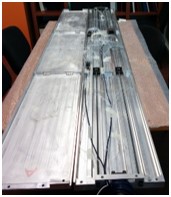
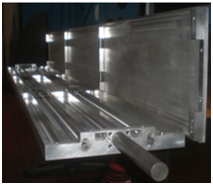
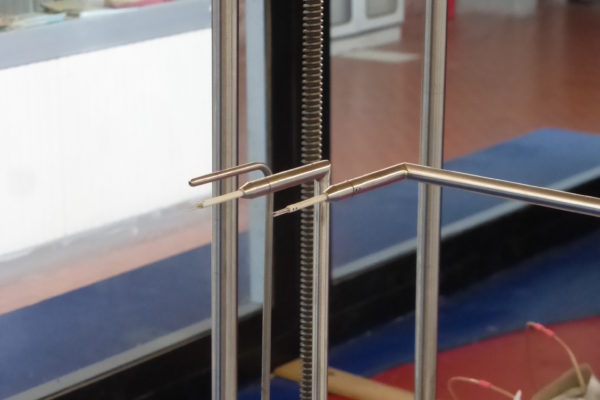
Wind actions on several Civil Engineering structures are estimated through wind tunnel tests. These tests can be either aerodynamic, aimed at evaluating forces and pressures on “rigid” models, or aeroelastic, where “flexible” models are used to reproduce the main dynamic characteristics of the investigated structure.
Pressures are measured through pneumatic connections, from pressure taps on the model surface to pressure transducers, which convert the pressure signals into electrical ones. The signals are then digitally acquired and logged by PCs, allowing detailed post-processing.
At CRIACIV, pressure measurements are currently performed using a DTC Initium Pressure System, equipped with up to 6 scanners of 32 channels each. With this configuration, each scanner can sample at 650 Hz, allowing simultaneous acquisition from multiple taps and capturing the pressure distribution across the model surface with high fidelity. The use of miniaturized piezoelectric transducers, often embedded directly within the model, minimizes the length of pneumatic connections and reduces signal distortion.
Expansion plans at the center include increasing the system to 9 scanners by connecting two DTC Initium systems in series, which will allow reaching approximately 285 measurement points. This will further enhance spatial resolution and enable even more detailed mapping of pressure fields on complex structures.
In recent years, large-scale campaigns have demonstrated the versatility of such systems. For example, in tests conducted on the Notre Dame Cathedral, pressure maps were composed from asynchronously acquired measurements, reaching a total of 1,200 pressure points. These high-density datasets highlight how modern pressure systems, combined with flexible acquisition strategies, can capture complex aerodynamic effects on real-scale structures, providing valuable validated data for both research and design purposes.