STOCHASTIC STABILITY (RANDOM FLUTTER) AND PARAMETRIC EFFECTS IN LONG-SPAN BRIDGE
Research activity duration: 2022 – now
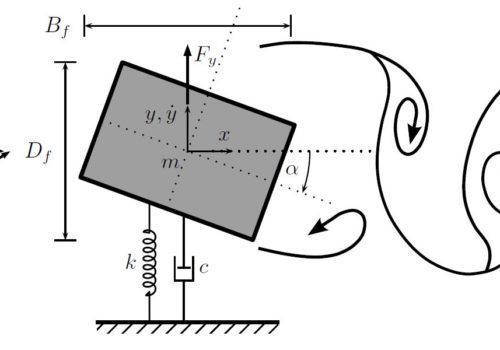
Classical bridge-flutter assessment typically relies on linear time-invariant (LTI) self-excited forces. In turbulent flow, however, the instantaneous aerodynamic behaviour changes in time (e.g., due to slow fluctuations of the angle of attack and of the reduced velocity), so the aeroelastic system becomes time-variant. This research clarifies two complementary turbulence effects on flutter stability:
• a “parametric excitation” mechanism, where time-variations of the aerodynamic coefficients can trigger resonance tongues and intermittent (random) instability;
• an “average parametric effect”, where nonlinear dependence of the aerodynamic coefficients on the varying parameter shifts in “average” aerodynamic stiffness/damping away from the classical LTI values.
The work combines (i) Floquet-based stability analysis of periodically time-varying bridge models and (ii) stochastic-stability analysis via Lyapunov and moment Lyapunov exponents, providing design-oriented stability metrics that connect directly to observable response thresholds.
Time-periodic parametric excitation and Floquet stability maps
A first step is to isolate and interpret the parametric mechanisms by prescribing a sinusoidal modulation of the governing wind parameter (e.g., angle of attack), which yields a periodically time-varying linear system. Floquet theory is used to compute stability boundaries as a function of mean wind speed and of the modulation frequency and amplitude. The resulting stability charts reveal resonance tongues associated with both modal coupling and parametric excitation, including near-horizontal instability boundaries (weak dependence on the pumping frequency) that are connected with the so called “average parametric effect”.

JWEIA (2024) – Fig. 6. Floquet-based stability charts: instability regions (“tongues”) in the plane of modulation frequency vs amplitude and mean wind speed, highlighting parametric-resonance mechanisms in a long-span suspension bridge model.
Average parametric effect: mean shift of aerodynamic damping and stiffness
Beyond resonance tongues, turbulence-induced parameter fluctuations also alter the *mean* aeroelastic properties. Because key aerodynamic derivatives vary nonlinearly and non-symmetrically around the mean angle of attack, the cycle-average of the time-varying coefficients does not coincide with the coefficient evaluated at the mean state. This “average parametric effect” can significantly modify aerodynamic damping/stiffness, and therefore the critical flutter condition, even when the parametric excitation frequency is not close to resonance.

JWEIA (2024) – Fig. 7. Map of the cycle-averaged value of an aerodynamic coefficient (linked to torsional aerodynamic damping) as a function of mean wind speed and modulation amplitude, for different mean angles of attack: a clear example of the average parametric effect.
Random flutter: Lyapunov and moment Lyapunov stability in turbulent flow
To move from idealised periodic pumping to realistic turbulence, the parameter modulation is modelled as an ergodic stochastic process and the bridge equations are treated as a linear stochastic system. Two stability notions are assessed:
• “sample (almost-sure) stability”, measured by the largest Lyapunov exponent (LE);
• “moment stability”, measured by moment Lyapunov exponents (MLE), relevant for the growth/decay of statistical moments and for quantifying the likelihood of large transient responses.
This framework links the onset of intermittent, turbulence-triggered instability to measurable response levels and offers a robust interpretation of “random flutter” events.

Nonlinear Dynamics (2024) – Fig. 7. Largest Lyapunov exponent versus mean wind speed under different turbulence conditions: transition from stable (negative LE) to unstable (positive LE) regimes.

Nonlinear Dynamics (2024) – Fig. 11. Stability index as a compact indicator of the transition across statistical moments near the stability boundary, for various turbulence conditions.

Nonlinear Dynamics (2024) – Fig. 5. RMS torsional buffeting response near the critical region: comparison of response trends with sample- and moment-stability thresholds.
Main outcomes and practical implications
- Provides a unified interpretation of turbulence effects on flutter as the combination of parametric excitation and an average shift of aerodynamic properties.
- Introduces stability metrics (LE/MLE) that complement classical critical-speed concepts and connect stability to probabilistic response levels.
- Enables time-domain, turbulence-consistent stability assessment for long-span suspension bridges, supporting both design checks and model-to-data validation with monitoring records.
Bibliography
BARNI, N., MANNINI, C., 2024. Parametric effects of turbulence on the flutter stability of suspension bridges. Journal of Wind Engineering & Industrial Aerodynamics 245, 105615. https://doi.org/10.1016/j.jweia.2023.105615
BARNI, N., BARTOLI, G., MANNINI, C., 2024. Lyapunov stability of suspension bridges in turbulent flow. Nonlinear Dynamics. https://doi.org/10.1007/s11071-024-09931-y
BARNI, N., ØISETH, O.A., MANNINI, C., 2022. Buffeting response of a suspension bridge based on the 2D rational function approximation model for self-excited forces. Engineering Structures 261, 114267. https://doi.org/10.1016/j.engstruct.2022.114267
BARNI, N., ØISETH, O.A., MANNINI, C., 2021. Time-variant self-excited force model based on 2D rational function approximation. Journal of Wind Engineering & Industrial Aerodynamics 211, 104523. https://doi.org/10.1016/j.jweia.2021.104523
BARNI, N., 2024. Largest Lyapunov exponent – Moment Lyapunov exponents. MATLAB Central File Exchange. https://it.mathworks.com/matlabcentral/fileexchange/168071-largest-lyapunov-exponent-moment-lyapunov-exponents