NONLINEAR BRIDGE BUFFETING RESPONSE MODELLING IN TURBULENT FLOW
Research activity duration: 2019 – now
Large-scale turbulence can generate slow fluctuations of the wind angle of attack, which may significantly modulate self-excited (motion-induced) forces acting on bridge decks. This mechanism introduces a time-variant aeroelastic behaviour that cannot be represented by standard linear time-invariant formulations, with potentially important consequences for both buffeting response and flutter stability of long-span bridges.
Modelling concept: 2D Rational Function Approximation (2D RFA)
This research develops a compact and physically interpretable framework to describe self-excited forces when the instantaneous aerodynamic behaviour is governed by a slowly-varying angle of attack. The core idea is to preserve the classical Roger-type unsteady aerodynamic structure, while allowing the model coefficients to become continuous functions of angle of attack.
A key contribution is the 2D Rational Function Approximation (2D RFA), where aerodynamic derivatives are fitted directly as bivariate surfaces in (reduced velocity/frequency, angle of attack). This avoids limitations of angle-by-angle fitting followed by interpolation, and provides a smooth and robust time-variant representation suitable for time-domain simulations.

Engineering Structures (2022) – Fig. 2. Hardanger Bridge sketch and deck discretisation used for the time-domain implementation of the time-variant self-excited force model.

JWEIA (2021) – Fig. 7. Examples of 2D RFA surfaces fitted to measured aerodynamic derivatives: continuous dependence on reduced velocity and mean angle of attack.
Wind-tunnel validation: controlled time-variant angle of attack
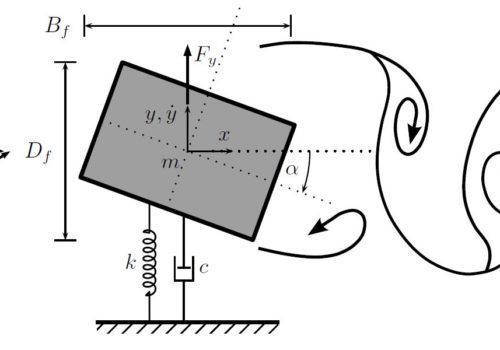
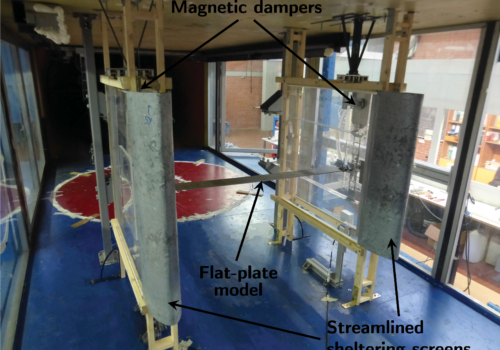
The model was validated through wind-tunnel testing using a forced-vibration strategy designed to reproduce the time-scale separation typical of full-scale turbulence effects: a high-amplitude, low-frequency pitching component generates the slowly-varying incidence, while a low-amplitude, higher-frequency component represents structural vibration. This makes it possible to directly verify the modulation of self-excited forces (amplitude and phase) induced by the slowly-varying angle of attack.
Details about this can be found in Barni et al. (2021).

JWEIA (2021) – Fig. 10. Experimental vs numerical comparison for a representative bi-harmonic test: time histories illustrate the time-varying modulation captured by the 2D RFA model.
In addition, a small variation of the mean angle of attack of the rectangular cylinder (1°) and to a low- intensity free-stream turbulence (around 3%) was investigated. The behaviour does not change substantially in these cases but a light incoming turbulence seems to promote the interference between VIV and galloping for intermediate values of the Scruton number (around 40).

Engineering Structures (2022) – Fig. 7. RMS buffeting response at midspan (lateral, vertical, torsional) versus mean wind speed: comparison among modelling assumptions and full-scale measurements.
Bibliography
BARNI, N., ØISETH, O., & MANNINI, C. (2021). Time-variant self-excited force model based on 2D rational function approximation. Journal of Wind Engineering and Industrial Aerodynamics, 211, 104523. https://doi.org/10.1016/j.jweia.2021.104523
BARNI, N., ØISETH, O. A., & MANNINI, C. (2022). Buffeting response of a suspension bridge based on the 2D rational function approximation model for self-excited forces. Engineering Structures, 261, 114267. https://doi.org/10.1016/j.engstruct.2022.114267
BARNI, N., ØISETH, O. A., & MANNINI, C. (2022). Nonlinear buffeting response of suspension bridges considering time-variant self-excited forces. PhD thesis, University of Florence–NTNU.
BARNI, N., ØISETH, O. A., & MANNINI, C. (2022). A model for nonlinear buffeting of long-span suspension bridges: application to a real structure. In 8th European and African Conference on Wind Engineering (EACWE), Bucharest, Romania, pp. 19–22.
BARNI, N., ØISETH, O. A., & MANNINI, C. (2022). A model for nonlinear buffeting of long-span suspension bridges: time-variant self-excited forces. In 8th European and African Conference on Wind Engineering (EACWE), Bucharest, Romania, pp. 511–514.
BARNI, N., ØISETH, O. A., & MANNINI, C. (2023). Nonlinear buffeting response of long suspension bridges considering parametric excitation due to large-scale turbulence. In IABSE Symposium Istanbul 2023: Long Span Bridges (pp. 351–358). IABSE. ISBN 978-3-85748-191-8.